
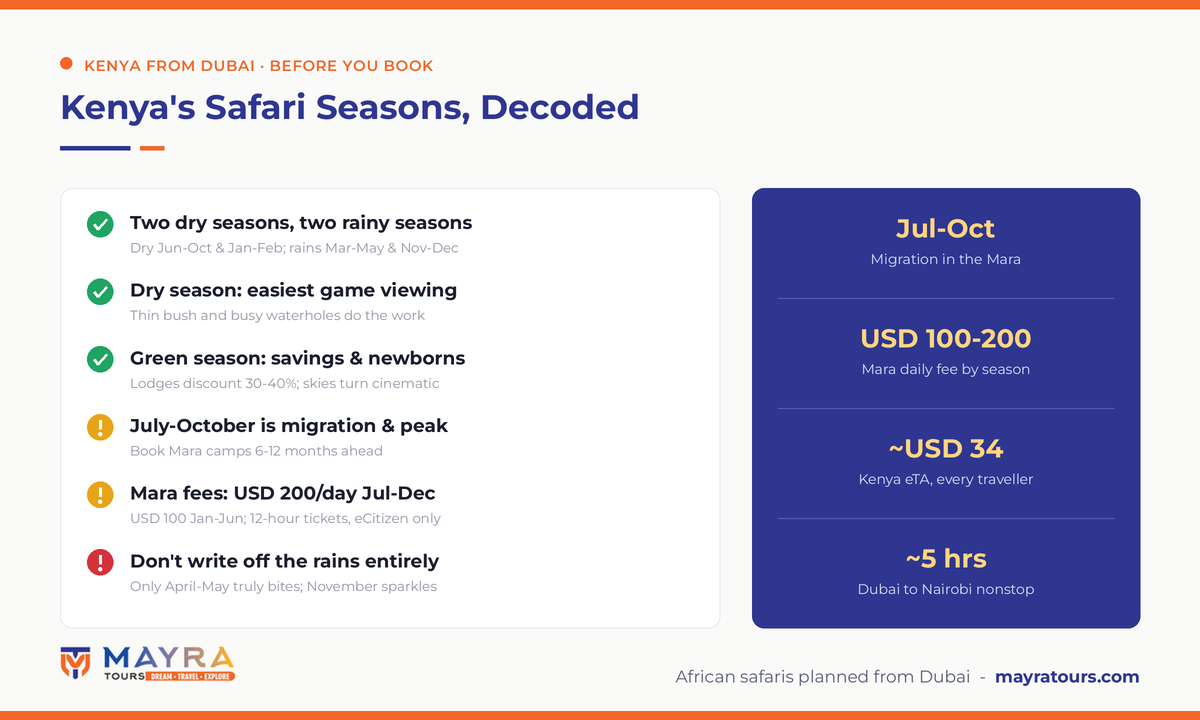
Quick answer: Kenya runs on two dry seasons and two rainy ones: dry from late June to October (the classic window, when the Great Migration fills the Masai Mara and thin bush plus busy waterholes make game viewing almost unfairly easy) and again in January–February; the long rains fall March–May and the lighter short rains November–December. Dry season buys certainty and pays for it with crowds and peak pricing, now amplified by the Mara’s seasonal park fees: USD 200 per adult per day from July to December, USD 100 January to June, on 12-hour tickets paid via eCitizen only. Green season buys 30–40% lodge savings, newborn animals, migratory birds and cinematic skies, and only truly gambles in April–May. Every traveller needs Kenya’s eTA (~USD 34, official etakenya.go.ke only, ~3 working days), Nairobi is about 5 hours nonstop from Dubai, and the honest verdict: first-timers chasing the migration book July–October a year out; value hunters and photographers take January–February or November and smile at the invoice. We build both from Dubai.
Our featured photo was taken on a Laikipia morning that explains Kenya better than any brochure: three reticulated giraffes, the rarer northern species with those crisp white-lined patches, crossing golden grass while Mount Kenya floats behind its own weather like a rumour. No vehicle queue, no checklist urgency, just the oldest landscape on Earth going about its business at dawn. The question every traveller asks before buying that morning is deceptively simple: when should I go?
And the honest answer is that Kenya does not have a “best time” so much as two different safaris wearing the same map. Dry-season Kenya is the certainty machine: wildlife compressed around water, grass cropped low, the migration thundering through the Mara, and prices to match. Green-season Kenya is the insider’s market: the same animals (they do not leave; this is home), plus baby everything, storm-light photographers dream about, lodges at 30–40% off, and afternoon showers that mostly behave like Dubai traffic: intense, brief, and done by dinner.
What tips the maths in 2026 is paperwork and park fees: the Mara’s seasonal pricing now doubles the gate cost in exactly the months everyone wants, which makes season strategy a budget decision, not just a weather one. This guide, the big-game deepening of our Africa cluster after Zanzibar tour guide from Dubai, decodes all four seasons, makes the case for each side, tells the migration truth, and prices the trip from Dubai. Verified September 2026.
Kenya’s Four Seasons, Decoded
| Months | What it is | The verdict |
|---|---|---|
| Jan–Feb | The short dry season: hot, clear, quieter parks, and the Mara at its USD 100 gate rate | The connoisseur’s window: dry-season viewing at half the gate fee |
| Mar–May | The long rains, peaking in April: lush, dramatic, some black-cotton tracks impassable, some camps closed | The gamble: deepest discounts, real weather risk; for repeat safari-goers |
| Late Jun–Oct | The classic dry season: migration in the Mara, concentrated wildlife, peak demand, and the USD 200 gate rate from 1 July | The showstopper: maximum spectacle, maximum price, book 6–12 months out |
| Nov–Dec | The short rains: brief afternoon showers, green flush, migratory birds arriving, festive-season uptick late December | The sleeper hit: November especially sparkles for value and light |
The Case for Dry Season
- The viewing physics: months without rain shrink the water map, so wildlife concentrates where the rivers and waterholes remain, and the grass drops from lion-hiding to lion-revealing height. You work less for more: this is why first safaris are usually booked here, and why guides can practically schedule the leopards.
- The migration bonus (Jul–Oct): a million-plus wildebeest and zebra spill into the Mara from the Serengeti, with the river crossings (more on those below) as the season’s crown jewels. Even ignoring the herds, big-cat action peaks because the buffet has arrived.
- The weather dividend: warm days, cool crisp mornings (pack a fleece for 6 AM drives; the surprise of every first-timer), essentially no rain interruptions, and lower malaria pressure than the wet months.
- The bill for certainty: July–October is when lodges charge rack rate, vehicles cluster at sightings in the reserve proper, and the Mara gate doubles to USD 200 per adult per day. The smart softener is the January–February mini-dry: 90% of the viewing physics, half the gate fee, a fraction of the vehicles. If you do not need the migration specifically, it is arguably Kenya’s best-kept open secret.
The Case for Green Season
- The maths: lodges discount 30–40% (sometimes more in April–May), the Mara gate sits at USD 100 through June, and the same room, guide and vehicle cost dramatically less; a luxury property that is aspirational in August becomes merely expensive in November.
- The wildlife, reframed: the animals live here year-round; rain redistributes rather than removes them. Green season adds newborns everywhere (gazelle, topi, warthog piglets in comic quantities), which in turn keeps the predators busy, plus migratory birds from November to April turning every drive into a second safari for anyone with binoculars.
- The photographer’s season: storm-stacked skies, rinsed air, golden grass against charcoal clouds, and dust replaced by colour; most of the portfolio shots that made you want Kenya were taken in exactly this light.
- The honest caveats: the long rains (March–May, April worst) are the real gamble: black-cotton roads bog, some camps close, and drives get rearranged around downpours; the short rains (Nov–Dec) are far gentler, typically an afternoon hour of drama and done. Our rule of thumb for first-timers: green season yes, April–May only with eyes open and flexible plans.
The Great Migration, Honestly
Kenya Safaris Built Around the Calendar
Tell us your month and budget; we will tell you honestly what that month delivers, price the Mara fees into the quote up front, time the eTA, and build the lodge-and-drives route: migration showstopper, January secret season, or green-season value run.
Costs & Logistics from Dubai: Fees, eTA, Flights
- The Mara fees, exactly: non-resident adults pay USD 100 per day January–June and USD 200 per day July–December; children 9–17 pay USD 50, under-8s free. Tickets are 12-hour passes (6 AM–6 PM), payment runs through Kenya’s eCitizen portal with no cash at the gates, and the rate is the same wherever you sleep. A 3-day August Mara visit therefore carries USD 600 in gate fees per adult before anything else, which is precisely why we itemise fees in every quote rather than burying them.
- The eTA, everyone’s paperwork: Kenya scrapped visas but requires an Electronic Travel Authorisation from every traveller, infants included (only East African citizens are exempt): about USD 34 with bank fees, filed at the official etakenya.go.ke only, since third-party applications are automatically denied, the same lookalike-site trap our arrival-card warnings keep flagging. Standard processing ~3 working days; apply a week or more ahead (up to 3 months), with passport, photo, accommodation proof and flight details to hand.
- Flights & health: Nairobi is roughly 5 hours nonstop from Dubai on Emirates and Kenya Airways, with October–February returns commonly AED 1,700–2,700; onward light aircraft hop to the Mara airstrips in 45 minutes or drive it in 5–6 hours. Malaria prophylaxis is generally advised for the Mara and coast (talk to a travel clinic), and a yellow-fever certificate applies only if you arrive via an endemic country, not on the direct Dubai run.
- The budget sketch, per person sharing: a solid 5–6 day mid-range safari (park lodges or quality tented camps, shared 4×4, all drives) typically lands around AED 7,000–12,000 plus flights in high season, with green season shaving 30–40% off the lodge line; luxury conservancy camps run far beyond. Kenyan shillings trade near KSh 35 to the dirham, cards and M-Pesa dominate, and tipping (guide USD 10–15 per person per day) is the working custom.
- The pairing move: Kenya’s classic second act is the beach: 2–3 hours more flying puts you on Zanzibar’s spice-island sand or Kenya’s own Diani coast, turning one long-haul into a bush-and-beach fortnight; our Indian Ocean files (Seychelles, Mauritius) cover the alternatives.
🦒 African Safaris, Booked Direct
Mayra Tours is a licensed Dubai operator (Tripadvisor Travellers’ Choice 2025). Safari quotes are where hidden costs love to hide; ours itemise park fees, conservancy fees and transfers line by line, in the season you actually picked.
- Custom Kenya safaris, any season →
- Zanzibar: the bush-and-beach second act →
- Seychelles from Dubai: the honest guide →
- Mauritius from Dubai →
- All international packages →
WhatsApp us your month; we will reply with what that month honestly looks like in the Mara, the gate fees it carries, and a route priced end to end.
Zanzibar: Africa’s Answer to “Where Next?”
Spice farms, Stone Town and turquoise flats two flying hours from the Mara: the classic safari-plus-beach fortnight, decoded from Dubai.
Frequently Asked Questions
For maximum certainty and the Great Migration, late June to October, booked 6 to 12 months ahead and priced at peak (including the Mara’s USD 200 daily gate fee from July). For nearly identical viewing at gentler prices, January to February is the connoisseur’s window: dry weather, quieter parks and the USD 100 gate rate. November rewards value hunters and photographers, while April and May carry real rain risk best left to flexible repeat visitors.
Mostly no; the wildlife lives there year-round, and the green season adds newborn animals, migratory birds, dramatic skies and lodge discounts of 30 to 40%. The short rains of November and December typically mean an hour of afternoon drama, not washed-out days. The genuine gamble is the long rains of March to May, April especially, when some tracks bog and some camps close; go then only with flexible plans and open eyes.
Non-resident adults pay USD 100 per person per day from January to June and USD 200 per day from July to December; children aged 9 to 17 pay USD 50 and under-8s enter free. Tickets are valid for 12 hours (6 AM to 6 PM), payment runs through Kenya’s eCitizen system with no cash accepted at the gates, and the rate applies wherever you stay. Bordering conservancies charge their own conservation fees instead for time on their private land.
In a typical year the herds enter the Masai Mara around July and remain through October, with river crossings clustering from July to September; exact timing follows the rains and shifts by weeks either way, so no operator can promise a crossing on given dates. Book inside the window, stay at least 3 to 4 nights, and treat the crossing as the jackpot on top of a spectacle that is already guaranteed: a million animals on the plains.
Kenya replaced visas with an Electronic Travel Authorisation that every traveller must obtain, including infants and previously visa-exempt nationalities; only East African citizens are exempt. It costs about USD 34 including bank fees, is filed exclusively at the official etakenya.go.ke (third-party applications are automatically denied), takes around 3 working days, and can be applied for up to 3 months ahead; we time it with every booking.
Flights run roughly AED 1,700 to 2,700 return on the ~5-hour nonstop, and a quality 5 to 6 day mid-range safari typically lands around AED 7,000 to 12,000 per person sharing in high season, park fees included, with green season cutting the lodge line by 30 to 40%. Budget separately for the eTA, tips (about USD 10 to 15 per person per day for your guide) and any Zanzibar or coast extension; we itemise all of it line by line in quotes.
Related Guides from Mayra Tours
- Zanzibar from Dubai: Spice Island, Stone Town & Safari Combos »
- Seychelles from Dubai: The Honest Island Guide »
- Mauritius from Dubai: Beaches, Budgets & Best Months »
- Sri Lanka from Dubai: Nature, Beaches & Heritage »
- All International Tour Packages »
Giraffes at dawn, storm-light plains and honest season advice: follow @mayra_tours on Instagram.
Pick Your Kenya Season the Honest Way
Send us your month and budget on WhatsApp. We will tell you what that month truly delivers in the Mara, quote gate fees and eTA up front, and build the safari, with the beach after it if you want one. We respond within 30 minutes (9 AM to 9 PM GST, Monday to Saturday).